
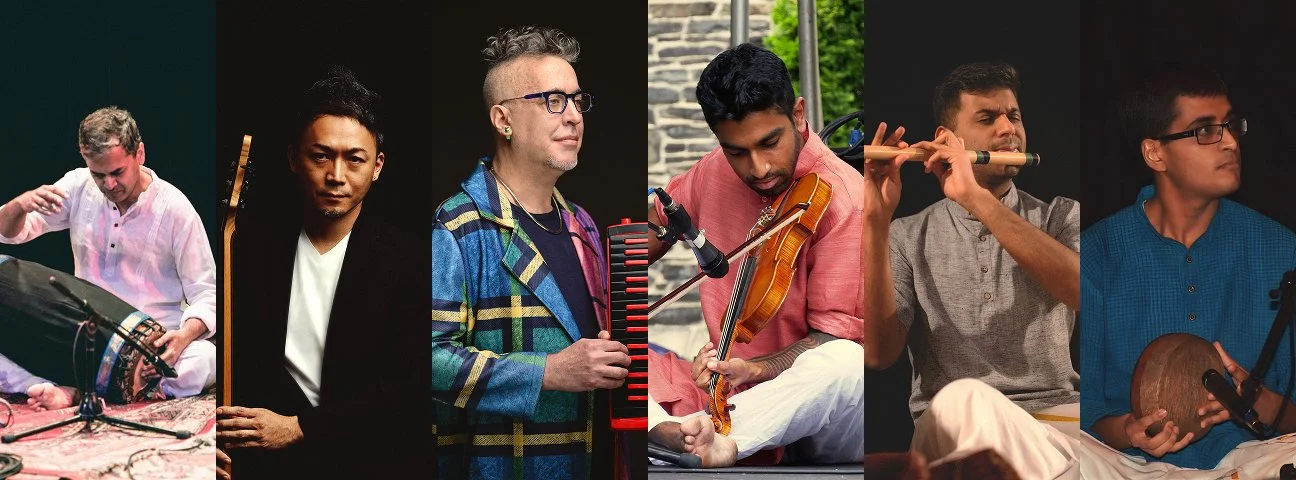
On Monday, March 9, Baruch Performing Arts Center, in association with Lyric Chamber Music Society, presents Akshara Music Ensemble. (Tickets available here.)
Building new forms on the foundations of Indian classical music, Carnatic musician, composer, and educator Bala Skandan formed Akshara in 2008, assembling New York’s strongest voices in Indian classical music to explore the crossroads of the traditional and the contemporary. We spoke to Skandan about what audiences can expect at the upcoming concert, how improvisation functions within their music, and much more.
How would you describe your music to someone who’s never heard it before?
Akshara’s music is rooted in Carnatic music — one of the two classical music traditions of India, the other being Hindustani — presented through a contemporary ensemble format. We combine intricate rhythmic structures, raga-based composition and improvisation with a broad instrumental palette. The result is music that is structurally Indian classical but designed to be engaging and accessible even for first-time listeners.
How does your style differ from traditional classical Indian music?
Traditional Carnatic music is presented in a highly codified concert format and is predominantly vocal in structure and orientation. Akshara keeps the core principles — raga, tala, and improvisation — but reworks them for a collaborative instrumental ensemble setting. Our compositions are arranged to gradually reveal rhythmic and melodic layers so audiences can follow the structure as it unfolds.
How does improvisation function within your compositions?
Improvisation is built into the structure of some of the compositions. Certain sections are designed as open frameworks where musicians respond to the raga, rhythm, and each other in real time. This keeps each performance alive and slightly different while still grounded in a defined compositional architecture.
Can you tell us about the formation of the ensemble, and how you decided on the name “Akshara?”
Akshara began about 15 years ago as an experimental ensemble bringing together musicians from different genres in NY to explore Carnatic rhythmic and melodic ideas in a collaborative format. Over time, it has attracted some of the best instrumentalists in NY who are open to learning and experimenting through this format. The name Akshara means “syllable” or “unit of sound,” and in rhythmic terms it refers to a fundamental unit of time. The name reflects our focus on rhythm, structure, and the building blocks of musical expression.
Tell us about the program you’ll perform at Baruch Performing Arts Center on March 9, 2026.
We’ll be presenting three works from our album In Time — Mohana Blues, Urban Kriti, and Sadjam — along with three newer compositions — The Passage, Surrender, and Broken. Together, the program moves across a range of ragas, rhythmic cycles, and emotional moods, and highlights both our earlier compositional voice and our more recent musical direction.
What can audiences expect to experience at the concert?
Audiences can expect a performance that combines rhythmic sophistication with clear musical storytelling. We present layered rhythmic development, melodic improvisation, and ensemble interaction in a way that invites listeners into the process. Some pieces are meditative, others groove-driven, and others structurally expansive — so there is variety in texture, energy, and emotional character throughout the program.
How do you make complex rhythmic music accessible to new audiences?
We introduce rhythmic ideas in stages rather than all at once. Listeners first hear a groove or motif, and then we gradually add subdivisions, variations, and improvisation. This layered approach allows audiences to connect with the pulse first and understand the complexity as it develops.